
Iron Condor – an efficient income generation strategy with high probability of success
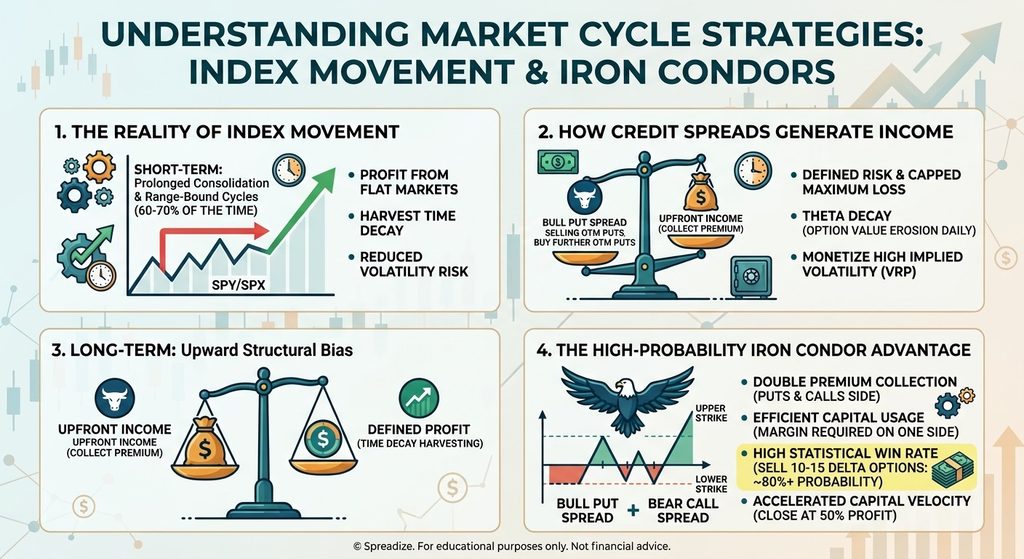
In Long term, major stock indices like SP500, Nasdaq etc., feature a strong structural upward bias driven by economic growth, corporate earnings, and inflation. However, in the short-to-medium term, indexes frequently spend a significant portion of their time (often estimated around 60% to 70%) consolidating or moving sideways within a range.
- Long-Term Upward Trend: Over multi-year and secular horizons, indices like the S&P 500 trend upward because underlying companies continuously grow, innovate, and generate profits, while poor-performing companies are automatically filtered out and replaced.
- Prolonged Consolidation Phases: In shorter timeframes—ranging from a few weeks to several years (such as the sideways “lost decade” markets of 2000–2013)—indexes routinely enter choppy, range-bound patterns while digesting macro news, interest rate shifts, or earnings cycles.
- The Basis for Range-Bound Strategies: Because indexes spend extensive periods oscillating between established support and resistance levels without a clear directional breakout, options strategies like Iron Condors are able to consistently harvest time decay during these flat or slow-drifting phases.
An Iron Condor is an income generation strategy using Credit spreads, which generates income by collecting an upfront cash credit from selling two out-of-the-money (OTM) option spreads—a bull put spread and a bear call spread—on the same underlying asset and expiration date. This initial credit becomes realized income as time passes or implied volatility falls, provided the underlying asset stays within your established price boundaries.
Structure & Mechanics
- Sell 1 OTM Put (Lower strike — receives credit)
- Buy 1 OTM Put (Further lower strike — limits downside risk)
- Sell 1 OTM Call (Higher strike — receives credit)
- Buy 1 OTM Call (Further higher strike — limits upside risk)
Core Drivers of Income Generation
- Harvesting Time Decay (Theta-Decay): Option buyers pay a premium for the right to a price move over a set timeframe. As the seller, time decay works in your favor every day the asset remains between your short strikes, causing the option contracts to lose value until you can buy them back at a cheaper price or let them expire worthless.
- Monetizing the Volatility Risk Premium (VRP): Implied Volatility (IV) routinely overstates actual real-world price movement. Initiating an Iron Condor when IV is elevated allows you to sell “expensive” option premiums and profit when volatility contracts back to normal levels.
- Dual-Sided Premium Collection: Because an asset cannot simultaneously blow through both your upper call strike and lower put strike at expiration, you collect credit from both sides of the market while only risking capital on one side.
Why It Generates Consistent Returns in Favorable Markets
- Profiting Without Directional Bias: Traditional equity strategies require a stock to rise to yield gains. An Iron Condor turns flat, range-bound, or slow-drifting market conditions into regular cash flow.
- Statistical Probability (Low Delta): Selling 10 to 15 Delta short options establishes wide price boundaries, creating a theoretical 80% to 85% probability of expiring out-of-the-money.
- Rapid Capital Recycling: Closing trades once they reach 50% of maximum profit shortens average holding periods from 45 days down to 15–20 days. This increases capital velocity, allowing you to redeploy collateral into new positions multiple times per year.
Structural Profile & Risk Controls
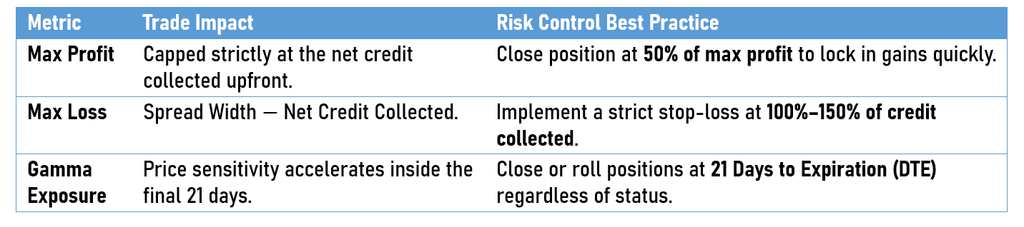
Average Returns from a 45 DTE SPY Iron Condor
When performing the strategy shown—selling Out-of-the-Money (OTM) spreads, entering during higher IV rank, and rigidly taking profits at 50% of the max credit—it is important to distinguish between Return on Capital (for a specific trade) and Annualized Return.
For a well-managed 45 DTE SPY Iron Condor that is closed at 50% profit:
- Average Return Per Winning Trade: A typical iron condor setup might receive a credit that is 1/3rd of the width of the spread (e.g., collecting $1.65 to risk $3.35, for a total $5 width). When you take profit at 50%, you keep $0.82. The return on the capital risked (margin) for that specific winning trade is approximately 20% to 25%.
- The Reality of Returns: While that 20%+ return looks impressive, you cannot simply multiply it by the number of cycles to get your annualized number. Losses will occur (which this strategy limits to 100-150% of the credit).
A historical, realistic average for a consistently performed, mechanical 45 DTE SPY Iron Condor strategy (with strict profit and loss management) over a diversified market cycle is generally an annualized net return of 8% to 15% on the dedicated options capital utilized for the strategy. While not a spectacular double-digit winner every month, it aims for consistent, high-probability compounding that often outperforms SPY’s raw average in low-volatility years
When trading Iron Condors on the S&P 500, the best candidates are assets that offer high options liquidity, predictable range-bound behavior, and a high Volatility Risk Premium (IV > Realized Volatility).
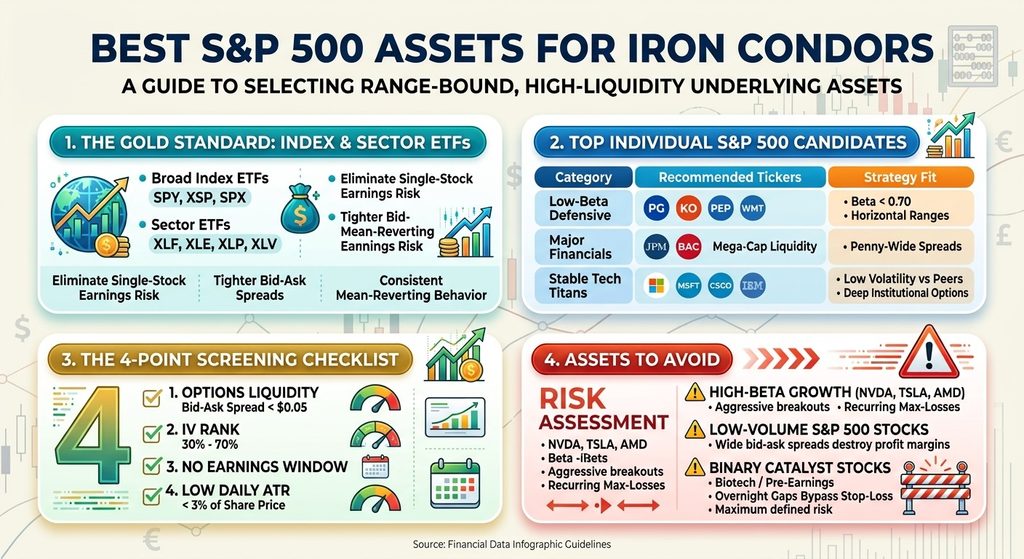
1. The Gold Standard: Index & Sector ETFs
For Iron Condors, broad index ETFs and S&P 500 sector ETFs consistently outperform individual stocks because they eliminate single-stock earnings gap risk and have the tightest bid-ask spreads.
- Broad Index ETFs:
- SPY (S&P 500 ETF): The ultimate benchmark. Unmatched options liquidity (penny-wide spreads), high frequency of range-bound cycles, and continuous multi-expiration availability.
- S&P 500 Sector ETFs:
- XLF (Financials): High option volume, lower price per share, and trades within tight ranges during stable rate environments.
- XLE (Energy): Frequently exhibits elevated Implied Volatility (higher credit collection) while remaining bounded by global oil supply/demand cycles.
- XLP (Consumer Staples) & XLV (Healthcare): Low-beta, defensive sectors that move slowly and predictably.
2. Best Individual S&P 500 Stocks for Iron Condors
If you prefer single-stock Iron Condors, you must select mature mega-caps with ultra-liquid options and moderate volatility rather than high-flying growth stocks.
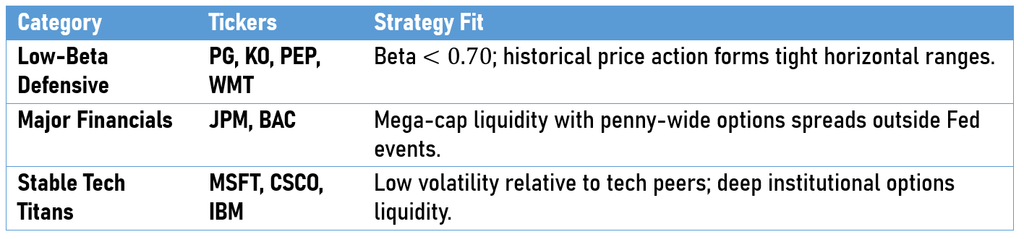
TOP INDIVIDUAL S&P 500 CANDIDATES
When trading single stocks, choose mature mega-caps with low volatility and deep option chains.
Income generation is an essential aspect about stocks portfolio. However, it is most times harder than usual fixed deposits and CDs that offer a very low-rate income. Whenever the market timing allows, these credit spreads strategies can be utilized to extract high yield income in slow boring sideways market price action. Get in touch with Spreadize for more simple to use income generation strategies for your specific portfolio.