
Utilizing the stock along with its options enables better risk control and stress-free management
Most Stock portfolios consist of just stock positions or ETF positions. The performance of each can be enhanced using combination of options along with the stock. We can explore ways to improve the portfolio exposure to technology sector by using QQQ – the Nasdaq 100 ETF.
Buying and holding the Invesco QQQ Trust (QQQ) is a core strategy for participating in the growth of top non-financial, tech-forward companies. However, relying solely on buy-and-hold leaves your portfolio vulnerable to market pullbacks and requires significant capital to scale.
Pairing a buy-and-hold base with QQQ debit spreads (specifically bull call spreads) creates a hybrid strategy that can enhance capital efficiency and hedge short-term movements.
Strategic Summary
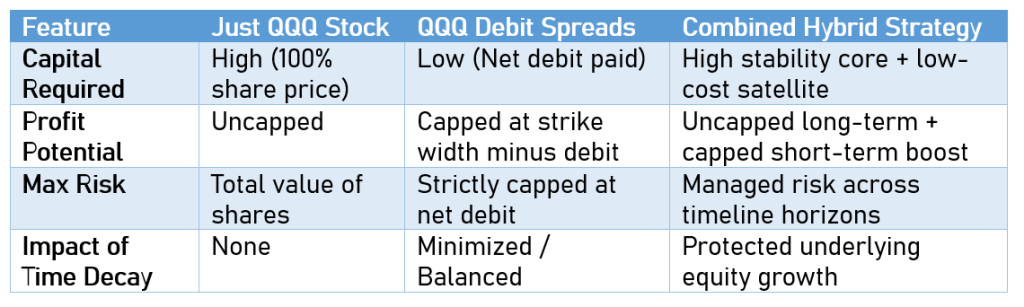
1. Capital Efficiency: Control More Growth for Less Cash
Buying shares of QQQ outright requires paying 100% of the current market price. A bull call spread—where you buy an In-The-Money (ITM) call option and simultaneously sell an Out-Of-The-Money (OTM) call option—allows you to participate in upside movement for a fraction of the cost.
- Buy-and-Hold: Requires full capital upfront, yielding returns tied 1:1 to price increases.
- Debit Spread Overlay: Controls 100 shares worth of exposure using a fraction of the capital (the net debit paid).
- The Synergy: Keeping your core funds in QQQ shares preserves uncapped, long-term wealth building, while setting aside a small pool of capital for debit spreads allows you to capture targeted upside moves with defined, lower-cost leverage.
2. Risk Mitigation: Defined Risk vs. Uncapped Volatility
When you own stock, your risk exposure equals the full share value if the market trends down.
- With a debit spread, your maximum loss is strictly capped at the initial net debit paid.
- Even if QQQ experiences a sharp short-term selloff, your loss on the spread position cannot exceed the initial entry cost.
- This defined-risk structure lets you trade short-term tactical setups (like bounces off the 200-day moving average) without risking major portfolio drawdown.
3. Neutralizing Time Decay (Theta)
A common challenge with buying single call options is time decay (where the option loses value each day as expiration approaches).
By selling a higher strike call option against your long call, the time decay collected from the short call offsets the decay paid on the long call. This makes debit spreads far more forgiving during periods when QQQ moves sideways or consolidates.
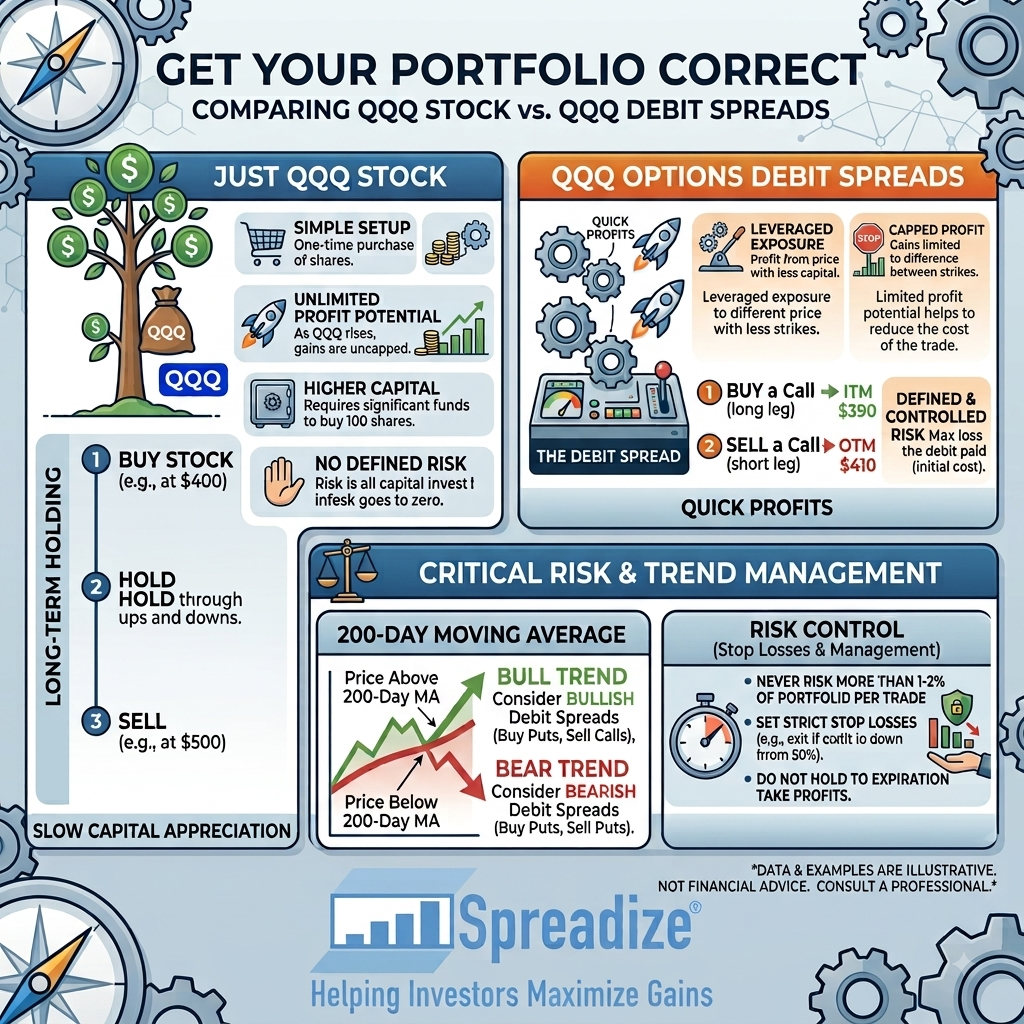
4. Accelerated Compounding Through Quick Profit Turnover
While your core QQQ shares compound steadily over years, debit spreads can generate short- to medium-term returns that can be realized and systematically reinvested:
- Identify the Trend: Use technical filters (e.g., price trading above the 200-day moving average) to enter bullish debit spreads.
- Take Profits Early: Close spreads at target profit thresholds (e.g., 50–70% of max profit) rather than holding to expiration.
- Reinvest: Funnel realized gains back into adding more QQQ shares or funding future defined-risk spreads.
The Bottom Line
Holding QQQ stock provides the base for long-term compounding. Adding QQQ debit spreads gives you a disciplined tool to extract cash flow during bullish trends, manage downside exposure, and systematically reinvest gains without overleveraging your portfolio.
To tap into the strategy, call us at Spreadize. We will study the existing portfolio and provide guidance to balance and optimize the positions based on existing market scenarios and your goals.