
Selective diversification can help avoid single stock concentration and yet capture upside trends
Individual growth companies offer a great way to get exposure to specific newly found industry breakthrough or unicorn stock IPOs. These companies generally keep growing until the business gets widespread appeal and competition tries to gain its market share. Although the stock’s value rises exponentially in most cases, the adverse events often happen suddenly and can erode large gains in the portfolio. In some cases, gaining growth access through ETFs is a better way to manage investments.
We will explore certain ideas that can utilize the broad market exposure through sector-specific exchange-traded funds (ETFs) like XLV (Health Care), XLI (Industrials), QQQ (Nasdaq-100 tech-heavy leaders), and SOXX (Semiconductors) and how it offers a structural advantage over picking single equities.
Why Sector ETFs Beat Single Stocks
- Built-in Diversification: Individual stocks carry company-specific risk, such as sudden earnings misses, executive scandals, or regulatory hits. ETFs bundle tens or hundreds of top firms, smoothing out idiosyncratic volatility.
- Capitalized Growth Without Single-Point Failure: A basket ETF guarantees exposure to an entire industry’s upward trend without requiring you to pick the ultimate winner.
- Lower Maintenance: Sector ETFs handle rebalancing and constituent updates automatically, saving you from constant stock-by-stock portfolio monitoring.
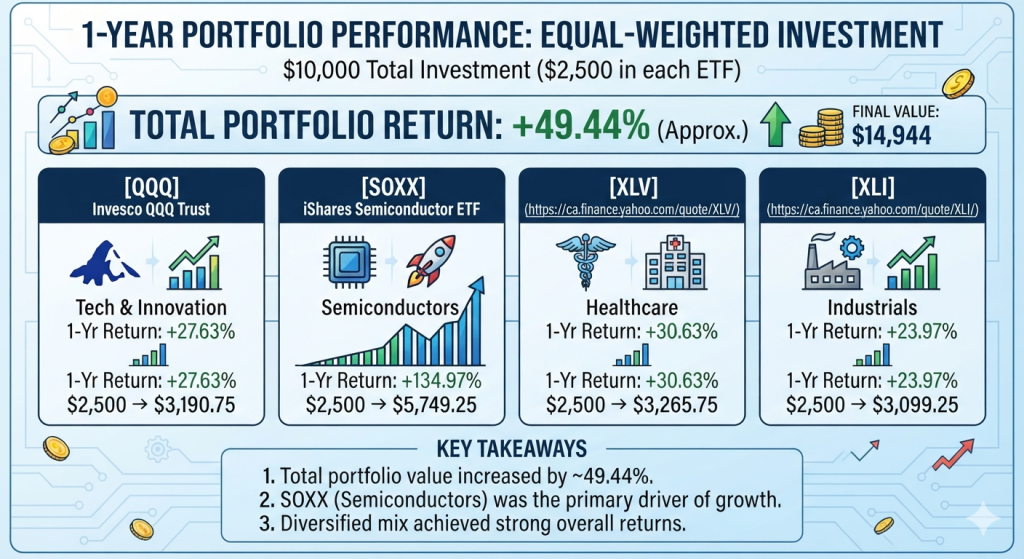
1-Year Performance & Chart Trends for example
- SOXX (iShares Semiconductor ETF): Over the past year, SOXX delivered a massive surge (+111% to +117% total return) driven by relentless AI hardware spending. Its price chart reflects an aggressive uptrend marked by steep ascents and occasional sharp pullbacks.
- QQQ (Invesco QQQ Trust): QQQ delivered steady double-digit annualized growth. Its chart exhibits a classic large-cap tech growth trajectory with high momentum and resilience.
- XLI (Industrial Select Sector SPDR) & XLV (Health Care Select Sector SPDR): These defensive and cyclical sectors provide lower-beta, steady upward sloping charts. While they track lower total returns than semiconductor momentum, they offer crucial downside protection and low-correlation stability when tech undergoes corrections.
Trend following can be utilized as initial Strategy with these ETfs
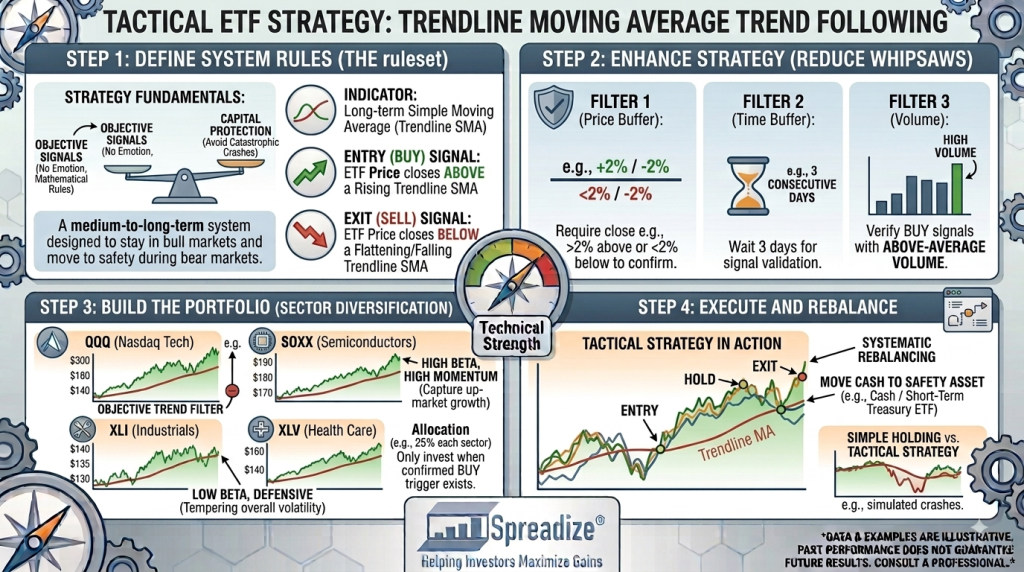
One of the foundational concepts in technical analysis for managing investment portfolios is implementing discipline using Trendlines. Using the trendlines similar to Moving Averages like 20-day Exponential Moving average (20-EMA) or slower moving-averages, we can form a tactical strategy designed to keep you in rising markets and move you to safety during prolonged downturns.
Visual Guide: A Technical ETF Strategy in Action
This infographic provides a clear walkthrough of the full technical strategy, from rules to real-world chart visualization.
Is it a good strategy to hold sector ETFs above their trend lines?
Yes, for many medium-to-long-term investors, this is a highly effective, objective strategy for risk management and capital preservation. It provides several key benefits, but also has inherent weaknesses.
The Advantages:
- Objective Signals: It removes emotions and guesswork from your decision-making. You have a clear, mathematical rule for buying and selling.
- Risk Reduction: Its main goal is to avoid catastrophic drawdowns—the types of market crashes (like 2008 or 2020) that can destroy portfolios. It systematically gets you out when the long-term trend breaks.
- Trend Participation: It aims to capture the majority of a major uptrend, staying invested while the sector is in a confirmed bull market.
- Portfolio Diversification: Applying this rule across different, non-correlated sectors (like XLI vs. XLV) can further smooth your overall returns.
To have a better understanding if ETFs can be suitable for your portfolio, please talk to us at Spreadize.