
Each stock has its own setup of spread strategies
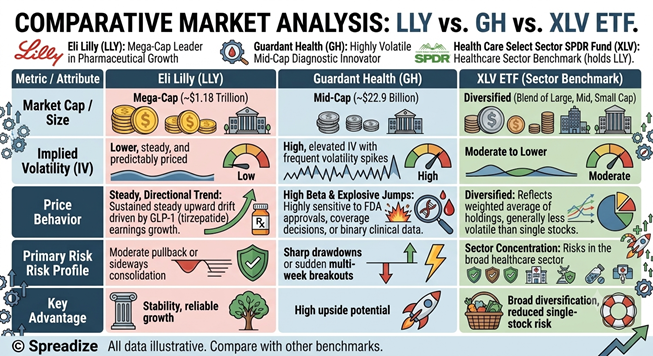
If we focus on explosive growth in GLP-1 drugs and medical equipment growing market in healthcare sector, we can select Eli Lilly (LLY) and Guardant Health (GH) as one of the few companies capitalizing on the sector strength. Comparing LLY and GH highlights two very different profiles in market capitalization, price stability, and volatility.
Market Profile & Fundamental Comparison
| Metric / Attribute | Eli Lilly (LLY) | Guardant Health (GH) |
| Market Cap / Size | Mega-Cap (~$1.18 Trillion) | Mid-Cap (~$22.9 Billion) |
| Implied Volatility (IV) | Lower, steady, and predictably priced | High, elevated IV with frequent volatility spikes |
| Price Behavior | Steady, Directional Trend: Sustained steady upward drift driven by GLP-1 (tirzepatide) earnings growth. | High Beta & Explosive Jumps: Highly sensitive to FDA approvals, coverage decisions, or binary clinical data. |
| Primary Risk Profile | Moderate pullback or sideways consolidation | Sharp drawdowns or sudden multi-week breakouts |
Why a Bullish Debit Spread is Better for LLY (Next 6 Months)
A Bull Call Spread (Debit Spread) involves buying an In-The-Money/At-The-Money call and selling an Out-of-the-Money call.
- Lower Volatility & Predictable Growth: LLY is a mega-cap stock with consistent revenue streams. Because its stock price tends to move in a steady channel rather than making parabolic 50%+ jumps overnight, a debit spread allows you to target a defined price range efficiently.
- Capping Upside isn’t a Major Penalty: Since LLY’s vast market cap restricts daily extreme percentage surges, capping your maximum profit at the short strike in a debit spread gives you a high probability of success without sacrificing realistic upside.
- Cost Efficiency Over High Vega Plays: Purchasing long calls alone on LLY can be expensive due to high share price. Selling the higher strike call offsets theta decay and reduces the initial debit, offering a capped-risk, defined-reward setup.
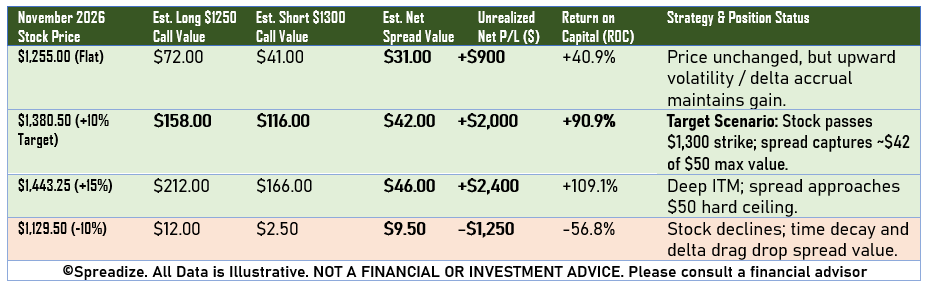
We will cover a scenario where we have a 10% increase from the initial $1,255.00 stock price brings LLY to $1,380.50 in November 2026 (3 months prior to the February 2027 expiration).
Because 3 months of time value remains, the $1,250 long call retains significant extrinsic value (time premium), and the $1,300 short call trades well In-The-Money (ITM). Based on Black-Scholes pricing models for long-dated options, the spread will trade close to $40.00 to $43.00 ($4,000–$4,300 per contract) in November 2026—capturing roughly 70%–80% of the maximum potential profit well before expiration.
LLY $1,250 / $1,300 Call Debit Spread: November 2026 Mid-Trade Matrix
Assumptions: Initial Net Debit Paid = $22.00 ($2,200/contract) in August 2026. November 2026 Stock Price = $1,380.50 (+10% gain).
Key Takeaways for November 2026
- Early Profit Capture: At $1,380.50 (+10%), you do not need to hold until February 2027 expiration to secure gains. Closing the trade early yields a +$2,000 profit (+90.9% ROC) while avoiding remaining time risk.
- Max Profit Ceiling: At expiration (Feb 2027), the maximum value of a $50-wide spread is $50.00 ($5,000). At $42.00 in November, you have already realized 84% of the $50 maximum possible value.
- Risk/Reward Decision Point: Closing the position in November eliminates the risk of a late pull-back in December or January for the remaining $8.00 ($800) of upside potential.
Why a Call Ratio Backspread is Better for GH (Next 6 Months)
A Call Ratio Backspread (e.g., Sell 1 ATM Call, Buy 2 OTM Calls) is designed to capture uncapped, explosive price moves while providing downside protection.
- Capturing Explosive Breakouts (Vol / Gamma Acceleration): Mid-cap liquid biopsy and oncology growth stocks like GH often experience rapid upward repricing on major announcements or earnings beats. With 2x long calls versus 1x short call, the Backspread benefits from uncapped 2x upside leverage if GH surges significantly past its breakeven price.
- Vega & Volatility Expansion: Because GH options carry higher implied volatility, any volatility spike (e.g., preceding regulatory news) inflates the option premiums. Because you own more long options than short options (net-long Vega), an increase in IV boosts the value of the position faster than it hurts the short call.
- Downside Floor at Zero Cost / Small Credit: If GH experiences a sharp correction or severe pullback, all call options expire out-of-the-money. Entering the backspread for $0 net cost (or a small credit) ensures zero capital loss on a complete breakdown, unlike holding direct stock or an unhedged long position.
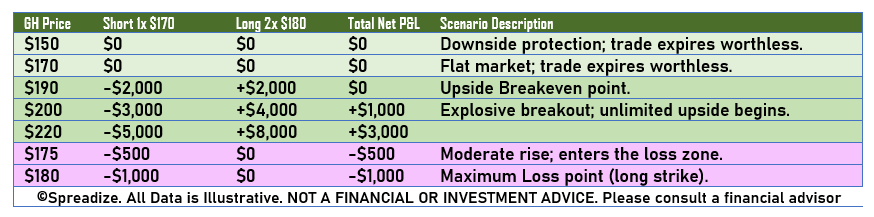
Based on Guardant Health (GH) trading at approximately $170.00, this is a hypothetical scenario for a 1×2 Call Ratio Backspread.
Hypothetical Assumptions:
- Stock Price: GH at $170.00.
- Strategy (1×2): Sell 1x $170 Call (At-the-Money), Buy 2x $180 Calls (Out-of-the-Money).
- Net Cost: Executed for $0 (even money) to isolate the payoff profile.
- Expiration: Prices represent Profit and Loss (P&L) at expiration, excluding commissions.
Summary Strategy Fit
- Choose LLY + Debit Spread: When expecting a measured, steady uptrend where defined risk and limited capital outlay are preferred over uncapped leverage.
- Choose GH + Call Ratio Backspread: When anticipating high volatility or an explosive breakout, where you want uncapped upward potential with downside protection if the stock collapses or stagnates below your lower strike.
In order to see if any of the healthcare sector stocks fit in your portfolio, please contact Spreadize for detailed strategy implementation