
Minimize Drawdown impacts and gain smoother upside trend
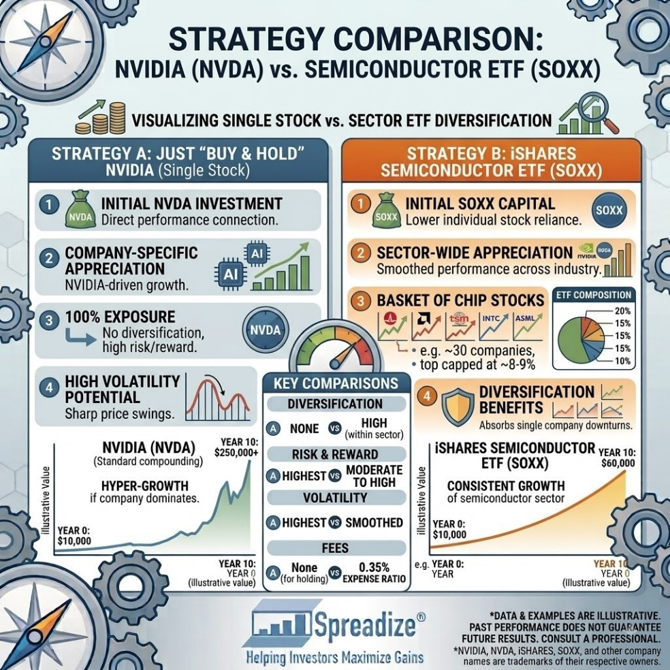
While Nvidia (NVDA) remains, the dominant engine driving the ongoing AI boom, relying exclusively on a single mega-cap chip stock for long-term growth carries inherent concentration risk. For long-horizon investors seeking sector exposure with a smoother risk profile, the iShares Semiconductor ETF (SOXX) offers a compelling alternative.
Why SOXX can be a good alternative for NVDA for the Long Haul
- Diversification Without Sacrificing upside: Single-stock picks face sudden execution risks, valuation compressions, and competitive disruptions. SOXX provides broad exposure across ~30 semiconductor leaders—including foundry giants (TSM), memory makers (MU), equipment suppliers (ASML, AMAT), and rival designers (AMD, AVGO).
- Built-in Nvidia Participation: Purchasing SOXX does not mean missing out on Nvidia. NVDA routinely serves as one of the ETF’s largest holdings (typically weighted near 7–9%), allowing you to capture upside while hedging against single-stock drawdowns.
- Value Chain Coverage: AI hardware require more than GPUs. SOXX captures revenue generated across the entire semiconductor supply chain—from lithography equipment makers to custom ASIC designers—ensuring portfolio growth regardless of which individual chipmaker wins specific sub-markets.
- Lower Volatility & Drawdown Protection: Mega-cap tech stocks regularly undergo sharp 30–50% pullbacks during sector cyclical downturns. An ETF structure dampens single-company shockwaves through automatic rebalancing.
Boosting SOXX Performance with Call Debit Spreads
For investors looking to outperform simple buy-and-hold returns without taking on uncapped risk, trading Call Debit Spreads (Bull Call Spreads) on SOXX provides leverage and downside control.
How the Strategy Works
- Buy a Long Call at an In-The-Money (ITM) or At-The-Money (ATM) strike price (e.g., Delta approximately 0.60 – 0.70).
- Sell a Short Call at an Out-Of-The-Money (OTM) strike price higher up.
- Pay a net debit upfront, which represents your absolute maximum risk.
Why Use Debit Spreads on SOXX?
- Mitigating High ETF Option Premiums: Broad sector ETFs can carry elevated implied volatility (IV). Buying outright calls is expensive. Selling the higher-strike call offsets option cost and combats time decay.
- Defined Risk & Defined Leverage: Your potential loss is strictly capped at the net premium paid upfront. Meanwhile, the percentage return on invested capital can significantly outpace holding shares directly if SOXX trends toward the upper strike by expiration.
- Ideal for Steady Sector Trends: Semiconductor stocks historically move in strong structural multi-month waves. A 60-to-90-day debit spread aligned with key technical support levels (like a bounce off the 200-day moving average) allows you to capture upside momentum with efficient capital usage.
Drawdown Protection:
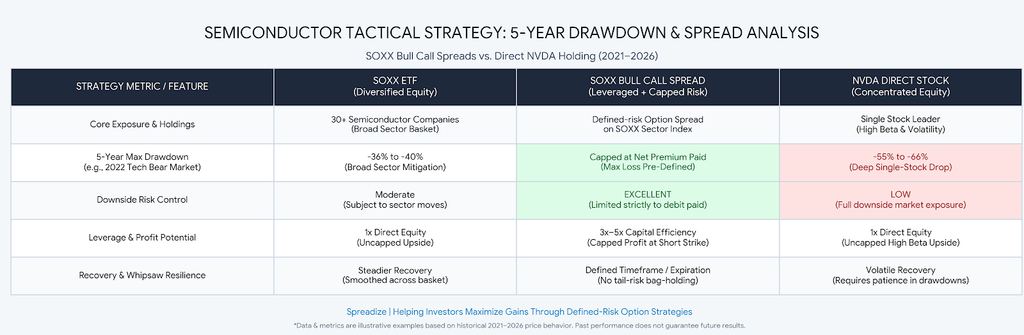
- NVDA experiences significantly deeper peak-to-trough drawdowns (often exceeding -50% to -60% during cyclical downturns) due to single-stock concentration and high beta.
- SOXX smooths out volatility across 30+ holdings, keeping broad sector drawdowns around -35% to -40%.
- SOXX Bull Call Spreads decouple your maximum risk from stock price drops entirely—your risk is strictly limited to the upfront premium (debit) paid, protecting capital during major drawdowns.
Capital Efficiency & Leverage:
- Buying SOXX Bull Call Spreads offers defined-risk leverage, allowing traders to participate in semiconductor upside trends while committing only a fraction of the capital needed to purchase shares directly.
This strategy initially looks complicated. However, once we realize the steps – it becomes easier and routine practice to select sector leaders and utilize the related sector ETF to enhance gains. Send us an email or message to Spreadize to learn to implement this in your portfolio.